Monday, December 22, 2014

To Kill a Mockingbird by Harper Lee

It was June 2007 and I had been assigned to read Harper Lee's To Kill a Mockingbird for my summer reading homework before I started my junior year of high school. The book was one I had heard of as being a classic and a renowned piece of literature yet I had also heard from friends who had already read it that it was dreadfully boring and dumb. My assignment was simple. I had to find 15-20 quotes for three pre-chosen themes and then hand write three 150 word essays about the themes and integrate my quotes. It was a simple summer task but for most it was a complete buzz kill. I have always enjoyed summer reading. There was never any pressure for you to read the book fast or for peer interaction. It was just me and a book and my thoughts. I found that I enjoyed the assignment. In fact, it was this book in particular that changed the way I viewed books and literature and writing.
I loved this book. My 16 going on 17 year old self was mesmerized by Scout and her innocence and the adventures she had that so often reflected my own childhood although we were years and worlds apart. I loved the simplicity of the novel and it's call for justice. When I turned the final page I was confident that this book would be taking it's place on my favorites shelf.
I hadn't returned to the book since then and was curious to see if it would hold the same quality reading it a second time. I reread Where the Red Fern Grows almost ten years after reading it a first time and found I didn't enjoy it nearly as much as my 12 year old self did. This may be because Red Fern was my first experience with a subtle title. I remember thinking how brilliant it was that the author named the book after something so beautiful as the flowers that grew on the dog's graves. When I reread the book, I was experienced with so many books that did something similar and therefore Red Fern lost it's "wow" factor for me. Luckily, Mockingbird wasn't the same type of experience.
Mockingbird indeed introduced me to a lot of literary tropes but it also shaped the way I look at literature. My growth only stemmed from my first reading of this book. The second read was just as good. I definitely gained a better perspective on Atticus this time around and teared up after reading his speech at Tom Robinson's trial. 
I keep asking myself, why this book? Why is this the book that gained all of the attention? Well, of course it is written well and it's message is unlikely to be beaten. But I also think there is a timelessness to the story that resonates with many readers. Not much happens in Scout's day to day life. She goes to school or gets in an argument with her pubescent brother or gets reprimanded by an adult. She is a child in a mixed up world and Lee is able to capture this moment of all of our lives with stand out moments yet we still feel we can relate. We may not have had a mad dog roam the neighborhood street but we did have  moments that united the neighbors or scared the neighbors. We may not be teased because our father is defending a man who is racially discriminated against but we did get teased and were accused of things we shouldn't have been.
The book offers a unique look at childhood and though some call it didactic, I say it is a call to do what is right in the face of adversity. This speaks very loudly to recent events in the media. Make of that what you will. It is a call to return to innocence. This book is a 5 star book still. It still holds up to me and it will hold up as long as we continue to pick up books and seek knowledge and understanding.

Monday, December 15, 2014

Saint Nicholas by Joe Wheeler

Saint Nicholas has acquired many names over the centuries: Kris Kringle, Saint Nick, Santa Claus. When we hear the name Santa we think of the man in the red suit with a jolly laugh and a large white beard. We think of Coca-cola bottles and reindeer and presents. Santa is generally seen as a jolly old soul whose mythical presence brings joy to every child on December 25th. But when it comes to the man Saint Nicholas, I think it is safe to say Santa is his secularized form. He is a pop icon with no more authenticity than a clown. And while the idea of Santa is a very nice one, I think it is safe to say that I am not the only person who is sick of his polarization. Santa has become more of a marketing tool...a way to suck kids in and make them behave this one time of the year. He is a pagan giant who supports department stores and malls all over the country. While Santa is fun as a kid, I really yearned to learn more about the man Saint Nicholas as I got older. When I saw this book at a bargain book store, I knew I needed to buy it for my own cause. I wanted to know who the really Saint Nicholas was.
I'm not a huge history reader so please forgive me when I say I found this book to be incredibly boring at times. While I am a huge reader I prefer to learn about history on the TV with visuals. That being said, this was a good book. Ir is a generally short read and is very to the point of who Saint Nicholas was and how he slowly molded into what he is today. I was very surprised to learn that Nick did more than simple anonymous giving while he was alive but had some involvement in politics of the church and was even imprisoned for his beliefs.
The author made sure to not skip over any detail about Nick's life, large or small. The first fourth of the book talks about Nicholas while he was alive while the rest discusses his impact over the centuries. The book does a great job at capturing how culture forms and how everything is connected. He talked about miracles surrounding the Saint (none of which I have heard of) and artwork and went into great detail about Saint Nicholas's transition from Saint to Santa. The book definitely has commentary on culture without being social commentary. This includes why people pray or why saints are so important and what it all means in the grand scheme of things. I also loved that the author explained how Saint Nicholas Day and the birth of Christ merged into one.
Overall, I was very touched by this book. I think it is a great read for the holidays yet can also be enjoyed as a religious or historical text. I learned a lot. I will give this book 3 out of 5 stars.

Monday, December 8, 2014

Harry Potter's Bookshelf by John Granger

If you know me than you must know I love Harry Potter and am always seeking out new material to study about these books. One author/speaker you can never go wrong with is John Granger, also know as the Hogwarts Professor. Granger is a pretty big deal. He virtually changed how I look at these books with his ring composition theory and always wows my brain on the podcast, Mugglenet Academia.
I've always been fascinated by the influences Potter claims and was so excited to tackle this book. If you are a big follower of Granger then this book may come off as a bit repetitive at times but at others it is utterly brilliant! The book makes so many fantastic connections and really holds Potter in the high standards that it deserves to be held in.
The book's beginning chapters were very good. Then the book slowed down a bit and became a tad bit boring (and I will admit I considered not finishing the book) but I pressed on and the rest of the book was epic! Granger made connections to Austen and Dante and works that were unknown to me that I have now added to my reading list.
Jo Rowling is a fascinating person and I love how Granger studies her to gain more access to the Potter world. This is a must read for any Potter fan. I will give this book 4 out of 5 stars.

Wednesday, December 3, 2014

Harry Potter and the Science vs. Religion Debate


Kathryn Applegate is the program director at BioLogos. BioLogos is an organization dedicated to showing the "harmony" between faith and science. In a recent article by Jesse Carey in Relevant Magazine, Carey quotes Applegate as she discusses the intersection of science and faith. "People have felt worried that if they go in one direction or the other; they're going to lose their faith or have to just stop thinking," Applegate says at the age of science versus religion debate. She continues, "I feel like it's a false choice between excepting the Bible or excepting science." Wait, so is she suggesting that these two things can be harmonious? Most people would tell her to come off it. But the truth is that there are a lot of truths intertwined in our world. The belief that science goes hand-in-hand with religion isn't a new idea but one that is currently taking force. Relevant Magazine strives to cover faith, culture, and intentional living and they certainly do that with Carey's masterfully crafted article.
Relevant Magazine isn't the only media form driving to bridge this gap. Another media form striving to bridge the gap is the Liturgists podcast. The podcast consists of Michael Gungor, Lissa Paino, and Science Mike as they discuss creativity through the lens of science, art, and faith. The program does a great job at breaking down barriers without insulting a particular group of people on the way and it strives to ask questions that make us uncomfortable.
But can a text or a podcast, or any media for that matter, that isn't aiming to discuss this topic teach us something about said topic? Let's find out.
I mentioned above that truths can be intertwined. Connections can be made anywhere and out of anything. Our world literally revolves in a circle, physically and metaphysically. That book you read last week resonates with the piece of you that reveals knowledge about certain history that connects to Galileo that connects to your crummy day job, etc. Here is an example. Harry Potter makes me very nostalgic for my days of youth group which is where I learned a lot about my faith and that Jesus loves us all which is also reiterated in Harry Potter when Harry fights for those who are oppressed by Voldemort who greatly resembles Hitler in his want to destroy those who he feels are below him, etc. See my point? Full circle. And speaking of Harry Potter, I found a very interesting connection which I believe can shed light on the science vs. religion debate.
There is a quote in John Granger's Harry Potter's Bookshelf where Granger discusses the feud that exists between the Hogwarts house Gryffindor and opposing house Slytherin. Slytherin's are, for plot purposes, the bad guys.  Granger notes on page 118, "Like all cultures, Hogwarts has a Founder's Myth: the story of the Four Founders and the break up of the once dear friends Salazar Slytherin and Godric Gryffindor. Ms. Rowling asks us to see how this story poisons the minds and hearts of all witches and wizards. This grand narrative causes not only the Gryffindor/Slytherin battle that is the good/evil axis of the story line, but also turns each magical person into a partisan defending their quarter rather than celebrating the whole. Gryffindor is core, Slytherin is 'other' from the Gryffindor side; Pure Bloods are core, all other beings are 'other' and 'lesser' to the Slytherins."
I want to pick apart this quote from Granger to connect it to the debate at hand. I trust you already noticed some sort of connection already. First of all, fiction itself is a reveler of truth. The concept of fiction being truthful sounds like crazy talk to many but take a look back at our ancestors who told the story of Pinocchio to their little boys to keep them from misbehaving or the Little Red Hen to encourage children to help. Yes, fiction is a great teaching tool although the examples I gave are stories written purposely to teach. But what about stories that don't aim to teach? Can they teach us on the same level as didactic stories? I'd argue these stories are more powerful because the reader is letting their guard down. It is when we let go of our preconceived beliefs that we absorb the most.
But back to Granger's quote...he frst discusses the Founder's Myth and states that all cultures contain something of the story. For Christians, this story is the Creation story and for others it is the Big Bang Theory and Evolution. These two ideas clash all of the time and it seems to go that you either believe one thing or you believe another. That simple. And in the Hogwart's Founders Myth, many people choose sides as well. The Gryffindor's side with Godric and the Slytherin's side with Salazar. They do this with no particular reasoning in mind other than pride and preconceived ideas.
Granger then talks about Rowling's intent with this story. He explains that right away, Gryffindor's and Slytherin's can not be friends or have the same morals because at the end of the day, Salazar left. This is very reminescent of the Capulet's and the Montegue's from Romeo and Juliet. Salazar Slytherin left Hogwarts and never mended his relationship with Godric Gryffindor which implies that the same will continue to happen. This very much mirrors a person's struggle with which side of the debate to be on. Do you go with the Creation story or do you go with scientific evidence? We are taught we can only choose one or the other and like Salazar we must leave one behind. Thus there seems to be no alternative. And as Granger states, we forget to celebrate the whole.
The entire Harry Potter series is about acceptance and I think it is important that we keep open minds
and try to learn from all areas of the spectrum. Besides the Gryffindor and Slytherin feud, another feud can be looked at as a personification of this debate as well and that is the feud between Hermione Granger and Luna Lovegood.
These two characters are always at odds. When defining them, Hermione would easily be the side of science and Luna the side of faith. Luna is constantly believing in things she cannot see or things that are said to not exist. Hermione relies completely on logic, especially in the final book when she doesn't believe the objects of a children's story could actually exist (these objects being the Deathly Hallows). Both of these characters mean a lot to Harry and both stand on opposite ends of the spectrum. The war calls them to come together and embrace their differences and try to learn from each other. As readers we are seeing through Harry and because Harry likes Hermione and Luna, we tend to agree. Why can't the same be said of science and religion?
There is a character in the series that is mentioned only briefly in the books and his name is Graham Montague. He is in Slytherin house. In the fifth book, Montague is stuffed into a broken vanishing cabinet (for those who don't know, a vanishing cabinet is always made as a set and when something/someone enters it they should be able to teleport to the other one easily) by the Weasley twins Fred and George. This is done because he joins the Inquisitorial Squad and as if this "privilege" isn't enough, he tries to abuse his new found power by docking rival house, Gryffindor, of house points. Fred and George take matters into their own hands and stuff him into the broken cabinet and feel not a drop of guilt. A moment like this could easily be passed off as house rivalry or the good guys (Gryffindor) triumphing over the stupid bad guys (Slytherin). But I think it is important to notice this Slytherin's last name...Montague. Ring a bell? Montague is the last name of the classic romantic character, Romeo from Romeo and Juliet. How coincidental this Slytherin is named after a character from a text that is promoting unity between arguing houses. It only makes sense that Rowling purposefully put this in her books. She did not randomly name this character. The entire series promotes unity between houses and this is a brilliant way at using subtext to establish a point. We are called to learn from these stories as they are allegory for our own lives.
The Harry Potter books are classics in their own right and what they can teach us knows no boundaries. I think it is important that people see this connection. Of course there are many other connections I could make such as the lion vs. the snake but I will end my blog here. It is important to connect Hermione and Luna and the Founder's Myth to this pressing issue because it will hopefully help us understand our own problems and put them in perspective.
What do you guys think about the science vs. religion debate? Do you see the connections I made? Can you make any other connections with other works of literature?

Tuesday, November 25, 2014

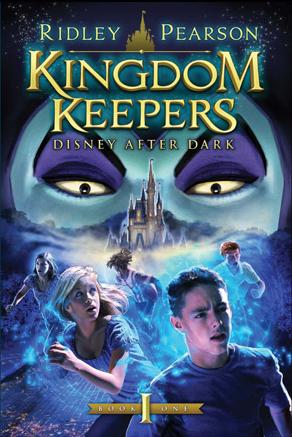
Literary Critic; Disney After Dark by Ridley Pearson

Hello, I'm the Literary Critic. I read it so you don't have to. Can we talk about Young Adult fiction for a moment? I mean, the genre is basically a brand these days from John Green to The Hunger Games. And while lots of YA is very good, there is also a butt load more that suck. Now don't get me wrong, every genre includes sucky titles. But YA seems particularly prone to the suckiest of them all. Why is this you might ask? Well, I think there are an array of reasons beyond all of our comprehension but the main reason that I've noticed is an author's ability to write down to readers. They don't try to write a genuinely good novel but write a silly story because it is assumed that kids and teens will drink that crap up. And that is just not true. Sure there are kids who enjoy the bad books but if they take an interest, how can we fault them? But there are many kids who seek good literature and lean toward adult novels to do so because the books in their age group have no appeal and just aren't good. And that isn't how it should be. A book should be good on it's own and not have to stoop down the story.
Oh, you think I'm wrong? You think these books don't exist? Well, they do dammit! Have you ever read Bridge to Terabithia or The Secret Garden or Sarah, Plain and Tall or Holes or The Lion, the Witch, and the Wardrobe or Harry Potter or Skellig or Matilda or...I think you see my point. So what do all of these books have in common? Well, they are good pieces of literature. They appeal to children's imaginations yet the writing holds up. The characters are developed and complex and the author is taking a simple story and painting it as a beautiful artwork. Yes, that is literature, and YA literature at that and it is so damn good! But lots of YA doesn't fall into this category. Why? Because lots of books seem to think that because they are in the children's or YA category, they don't need to write credible scenarios or unique characters. As long as there is an adventure, kids will eat it up. And that is a big issue in my opinion. I take issue when adults say, "well at least they're reading." Kids shouldn't be subjected to lazy writing. They should get a book that took the time to really write a good book and not just because it is for kids.
Now I know what you may be thinking. I'm a 24 year old woman. Why would I be reading books below my age group? Well here is the problem: books can be written toward an age group but should not be limited. This goes for all art. Sure there are shows like Barney that aren't necessarily good but that show is aimed to teach kids things like colors and rhymes and numbers and has no real merit beyond that...and even the characters on Barney are more unique than those in some YA books. But look at another series called American Girl. Those books could easily be looked at as marketing strategies to sell more dolls and make more money but if you actually sit down and read the books, they are actually very well done. Sure the writing isn't perfect but there are never any inconsistencies, the characters are well developed and you learn a lot about culture and history along the way. I read them last year and really enjoyed them. Sure they had their problems but all books have those. My point is, there is a difference between a children's book and a childish book. The first being a genre and you can expect fantasy and lots of hypothetical situations but altogether fun, the second being poorly written and the author being outright lazy because of the genre.
So with that in mind, let's talk about the first book of seven (there are seven books of this garbage??) in the Kingdom Keepers series titled Disney After Dark. Okay so what is this book about? Well we begin with a boy named Finn. He is the typical handsome white male who lives in Florida and is pretty famous because of his role at the Disney Parks. Finn along with four other kids, whose names I can't recall because they are all so boring and generic, are DHI's which stands for Disney Host Interactive. The kids are essentially actors and they have filmed scenes where they talk about rides and the park. These holographic images are then digitally projected in the parks for guests who need help. One night, something acts up in the Disney servers and Finn's dream becomes a reality when he finds himself at the park in his DHI form after he goes to bed and the park is closed. There he meets Wayne, the obligatory wise old man, who cryptically talks to Finn even though he has no reason to. We learn that the parks are in trouble and that the DHI's are the only ones who can save the parks, and apparently the world. That's right. The DHI's must defeat Disney villains come to life because they want...what else? World domination...because that isn't cliche. Anyway, Finn seeks help from a girl in his school named Amanda who is keeping a secret of her own. Oooooh, mysterious! With Amanda's help, the DHI's try to solve a mystery that will bring peace back to the parks and let them sleep without entering their DHI forms ever again.
The premise sounds a little rough but not too bad. I was interested when I read the back cover of the book. The book had some good parts...or, well a couple. Okay two or three. The concept of the DHI's is cool and questioning technology and our relationship with it is awesome. At one point Amanda sees a theme park goer walk through a DHI hologram and comments that it is rude and I thought it was awesome that this book may be asking the reader to question her logic. Like, is it actually rude when the DHI's aren't actual beings but just projected images? But the book never really got to that place again. And okay, parts of the ending I didn't see coming. But this book still sucks. Boy does it deserve to rot in a garbage dump. This book was so bad that I actually wanted to kill myself. And let me mention that I hate suicide notions and never make them...except this one time because it is necessary. I mean, I really wonder if the author had a hat full of plots and just reached in for an easy explanation or a random piece of generic dialogue or some kind of crap to end the chapter. The entire book was so ridiculous and contrived that this wouldn't surprise me.
Let's talk about the characters first because they were by far the worst part of this book. First off, what utter vanilla characters we were given. I like to think of all of them like balls of grape jelly...or, whatever jelly you want to imagine. It doesn't matter to me. There is no authenticity or character integrity to them. They just shape into the form the author desires. If the author wants a suave character, he's got it. If the author wants a fighter, he's got a fighter. But when you remove the jelly from it's fighter or suave jar, it will never stand on it's own. It will always fall flat. And that is essentially what these characters are, flat. Between the rotten dialogue and horribly forced interactions, one wonders how this book was even published in the first place. I mean, what sort of person would allow this junk to print?...Let's look at some direct quotes, shall we?
At the end of one of the chapter's, a woman isn't taking Finn seriously because of his age. She notes he is 13 and Finn corrects her, "14. I will be 14 next month." So wait, you are 13 then? Well isn't he a smart character. When someone states his age he feels a need to correct that person that they are right yet it is supposed to come across as smart. Yeah...cause that isn't stupid. I mean, why would this piece of dialogue be allowed in any text? I feel disgusted just featuring it in my review. Here is another example of the stiff dialogue. Finn is looking for clues with another DHI and says, "Hey guess what? We haven't got a clue." The other DHI then responds in annoyance, "That's a sick joke." Wait so, that was...a joke? Am I too old to get it? Or are these kids smoking something?
But my favorite quotes by far were from conversations between Finn and Amanda. I mean, these don't get any dumber. And it isn't just their dialogue, it is the narration and the ridiculous story that they are placed into. The story sets it up as if Finn and Amanda only know each other from passing in the school halls or having a class or two together. When Finn asks her for help...*POOF*...they are suddenly destined to be a romantic item. Finn will be confused by Amanda's girlish wit and Amanda will be jealous when Finn talks to any other girl. How adorable. I love teenage romance. My favorite TV station is ABC Family and the Lifetime Network. There is a part where the two are riding bikes and the narration goes, "Amanda stayed in the lead on her bike. Thankfully, she hadn't asked any questions, and he took this as a sign they were becoming really good friends." A silent woman! Men love these! Don't speak your mind girl, Finn likes it. It makes him feel much more comfortable than having to explain himself to you. A passage like this could be viewed as subtle and quite good but it just doesn't work with these characters. They are the most vanilla of the bunch yet we spend the most time with them! They also constantly contradict themselves. In this passage Amanda isn't upset with Finn for not telling her anything yet just a few chapters ago she was fuming at him for the same thing. And Finn contradicts himself within a page and a half when he states he respects the one DHI for being smart and then says how annoying his smarts are. WHY DO THESE CHARACTERS HAVE NO CONSISTENCY???!!!! WHERE IS THE DEPTH?? WE DON'T NEED MORE STEREOTYPES!!!
Even the adults are black and white cliches. Take Finn's mother for example. She is the mother that cries when her son goes anywhere with a girl. Oh Finn got paired with a girl in science. I bet they will get married! My boy is growing up! His mother also asks questions and grounds her son yet doesn't follow up when necessary. Like the entire book is her grounding Finn but when Finn starts breaking the most rules, she is out of the picture. She is only included when it is convenient for the plot. How nice. But Finn's mother isn't the only suspicious adult. All the adults are suspicious and not in a credible way but again just for the sake of the plot. Even when Finn asks an innocent question they are on to him like dogs sniffing for drugs. Finn could have asked for a strawberry ice-cream cone and they would reply, hey punk why don't you order vanilla to match your personality?
Oh, and I forgot to mention that Finn's lady friend is not only vanilla but angelic. Yep, she is literally an angel. The book goes out of it's way to establish that Amanda lives in an old church and tries to set up beautiful imagery but I think it is safe to say the author just flew too high without a parachute. I mean, what Ridley Pearson did to Amanda is identical to what Stephenie Meyer did to Bella in Twilight. It just isn't good writing and completely missed the mark. Speaking of missing the mark, let's talk about the author setting up situations and not tying them up at the end. I already talked about Finn's mom and her lack of parental control when it is beneficial to Finn's plot. Let's talk about a scene in one of the early chapters of the book. Finn and Amanda visit the parks one day without permission (Finn needs to carry a special pass with him when he visits the parks because he is a DHI) and are chased by a bunch of security guards. Amanda angelically saves them by finding a secret passage way and they narrowly escape the guards. Once the guards that were chasing them walk away, Finn and Amanda walk out into the open and suddenly everything is normal. I'm almost positive they go and get ice-cream or something along those lines (I can't check the source material because I threw that book away the moment I finished the last sentence so I apologize for that). So...wait, isn't Finn wanted still?...won't other security guards see him?...how can he magically be wanted one minute but off free the next?....oh screw continuity. Let's just let the kids have fun at Disney World even though it contradicts the entire chapter we just read. No big deal.
This is one of the many plot holes in this book. Other plot holes include the fact that Maleficent magically comes to life yet Finn and the other DHI's actually see people dressed up in Mickey and Cinderella garb. How does that work? Well...it doesn't quite frankly. The ending was atrocious. The story essentially breaks the law of physics when Finn can suddenly become a DHI anytime he wants and at the end of the book he simple spins around and *POOF* the spell is broken. The story never was set up to be a fantasy. It is set up as science fiction where a person can enter another realm. How easy of the author to switch genres for plot convenience. It is the sign of poor writing and poor plotting. And I bet you thought this book couldn't get any worse, right? Well you are dead wrong because it can! This author has no basic knowledge of Disney history and Disney World. At one point he refers to the Hollywood Studios nighttime spectacular as "Fantasmics" instead of "Fantasmic". Good job buddy. You have absolutely no concept of your source material. Always the sign of a good author.
This book is awful! And I know awful! I read Twilight. And this was worse! I feel like the author is trying to get us to purposefully dumb ourselves down. This Night at the Museum recreation is full of contradictions, bland characters, over dramatized situations, and stab you in the eye dialogue. The book should have a warning on the back that the side effects of reading it include self harm, please keep all readers away from sharp objects and prescription drugs. Between the forced relationship between Finn and Amanda and the awful one liners, I was lucky to not bring a gun to my head. This has to be one of the worst books I've read in a long while and to think it is a series is mind boggling. I wouldn't return to this series if my life depended on it!
The only part of this book I enjoyed was the first paragraph of a later chapter on page 244 and it says, "The transportation and ticket center hummed with conversations as a tangle of park visitors shuttled between buses and monorails. Some families were ending their days just as others were starting theirs. On a Monday afternoon, thick with humidity, the tired and impatient mingled with the exhilarated and anxious. For some, a day spent; for others, an evening full of promise. The humidity hung in the air so heavily you could practically wear it like a coat." Okay, why couldn't the entire book be like that one paragraph? It was a diamond in a whole lot of rough.
What do I think of this book? Well, it pretty much blows. It is the worst bunch of words splattered on paper. I've never wanted to barf so much in my life. This could be the book that would turn kids off to books...like when you visit a fast food chain and vomit and vow to never go there again. Well this is the vomit that scares a kid from reading and makes them think it is stupid. There are some good moments...well two to be exact, which is not enough to redeem this awful awful excuse for a book. A stupid movie I could see. But a book? This is just despicable. 1 out of 5 stars from me.

To whom it may concern: This review was a parody of two things, 75% Nostalgia Critic and 25% Literary Disco podcast. This review most definitely reflects my views though I expressed them in the form I was parodying.

Monday, November 17, 2014

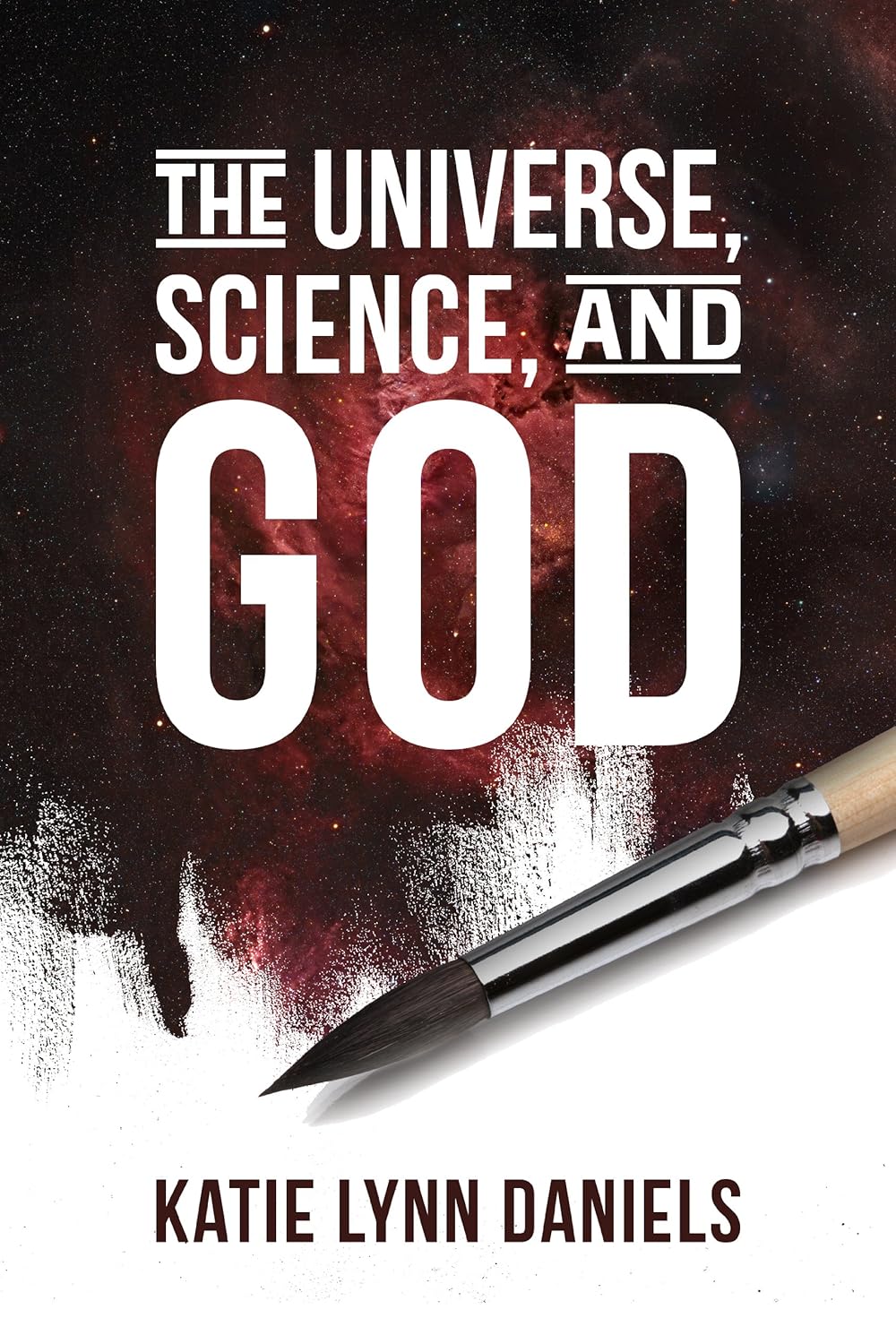
The Universe, Science, and God by Katie Lynn Daniels

Well, it has happened. I have read my first e-book. I'm not going to go into a detailed report on why I despise e-books but it is important to be aware of my distaste. I have never bought an e-book...well, okay I bought one about C.S. Lewis. When I will read it, who knows. It was discounted. But I don't plan to buy any in the future nor do I plan to ever by a tablet or e-reader as it seems counterproductive in my opinion. But that is just my opinion. I know many people love them and love the convenience aspect of it all and that is fine. I will end it there. Anyway, when you look at the books app on my iPhone you will notice there are quite a few e-books stored there and may question my authenticity. I will respond by telling you that these books have been downloaded for free...and no, not illegally. Most of the books on my phone are offered for free from a website called Noise Trade. Noise Trade is where I downloaded the book I am reviewing today titled The Universe, Science, and God by Katie Lynn Daniels.
I am very interested in the relationship between science and theology so naturally when I saw this title on Noise Trade I had to download it. I feel that this book was probably a poor choice to start off my first e-reading experience for when I finished it, I seriously questioned if this was even qualified as a book and what was the book's purpose. The text really has no thesis apart from the title which really isn't a thesis and it seems to be just random thoughts that would be better suited for a journal or blog entries. In fact, why isn't this a blog? It is a shame because if this sort of thing was a blog, I would definitely be reading it. It poses a lot of great questions and each chapter is the length of a typical blog entry. But as a book it just doesn't seem to work because there is no clear thesis and it doesn't serve to accomplish anything and I believe these things are what brought the book down. Not only that but the book was way too short to tackle such a big issue.
I won't go as far to say that the book had no strong points. It posed a lot of interesting questions and seems a great starting point for people who may be interested in learning about this topic. I really liked the beginning when the author discussed the second law of thermodynamics and that disorder must increase with time. I also liked that she made a connection to the popular show Doctor Who and how the complexity of life is metaphorically represented in that show...although I don't actually watch Doctor Who.
Overall, this was an underwhelming read. It is forgetful and has way too many drawbacks for it's medium. It would either be better suited for a blog or need to be expanded upon to make it a more concise and solid work. I also should add that I in no way think Daniels isn't talented. I would love to talk with her and have a conversation. I give the book 2 out of 5 stars.
If you want to download the book, visit this link!

Monday, November 10, 2014

The Gospel According to Disney by Mark I. Pinsky

When I was 15, I attended church camp for a second time. As much as I want to go into great detail about my experiences there, I will spare you the reader and get to the point that relates to this book review. My friends and I were at evening chapel, soaking in what the Pastor was saying. Suddenly, he stepped aside and the lights dimmed. The screen lit up in a blue glow and once our eyes adjusted it became apparent we were watching a clip from a Disney movie...and not just any Disney movie but The Lion King, one of my all time favorites! What does The Lion King have to do with church? I asked myself. Let me paint the scene for you. Simba has just reunited with his childhood friend who believed him to be dead and confronts him with his past that he thought he left behind him. Angry, confused, and lost Simba walks to the water and stares at his reflection in the water. Suddenly, the peace is disturbed by the wise old Rafiki who tells Simba he knows he is Mufasa's boy. When Simba tells him his father is dead, Rafiki disputes him and tells him his father is alive and he can see him if Simba follows Rafiki. Simba follows and they arrive at another body of water. Rafiki tells Simba to look and when Simba looks at the water, he only sees his reflection. Rafiki urges him to look harder and suddenly Simba is starring at the image of his father. Then Rafiki says the iconic words, "You see, he lives in you." There is a loud rumbling and in the sky stands Mufasa, urging Simba to stop running from his past and to take his place on Pride Rock as King. When Mufasa's ghost fades, Rafiki furthers his message by saying, "Oh yes the past can hurt, but the way I see it you can either run from it or learn from it." Hans Zimmer's score beautifully clashes with the African choir as Simba makes his decision to return to Pride Rock. Tears welled up in my eyes. A great deal of my emotion stemmed from the nostalgia I was feeling. But it was also more than that. I had never known that faith could be seen through "secular" entertainment. Yet here was a perfect example. The Christian symbolism was so clear to me at that moment and it is one of the defining moments of my adolescence for it is the moment that inspired me to study other entertainment and look for hidden meanings in other media I encountered. I began searching for books that discussed this topic of Christian symbolism in Disney films and soon came across this book, The Gospel According to Disney by Mark I. Pinsky. I couldn't wait to read it.
This book is not what I expected at all. While the title implies that the author will be picking out bits of the gospel that are ingrained in Disney films and discussing them, it is quite the opposite. The book begins with a long chapter discussing Walt Disney's relationship with Christianity and faith in general. It takes a deep look at Walt's childhood that greatly summarizes the man the public came to know and either adore or despise. The book then goes into separate chapters discussing a different movie each chapter. Part one of the book focused on the films that were made while and a little after Walt was alive. Part two focuses on the Michael Eisner years. Once again, Pinsky provided a good look at Eisner's relationship with faith. It then goes into a bit about the theme parks and the Baptist boycott. 
Critical reviews of this book are very positive while the reviews I saw online were extremely negative. This made me wonder a great deal, for I was on the latter side. I did not think this book was very good. But I think it is the title that either helped the book or made people cringe at the book. I already stated what I expected this book to be. However, I realize the title can be read another way. Rather than picking out the deeper Christian gospel messages of these films, this book gave a detailed look at Disney's relationship with culture and general religion. It didn't really look for the deeper messages but at surface level material - what Disney the company did, what it would look like if people clung to the films as a religious entity, etc. While this was also a good approach, it has already been done before. None of Pinsky's chapters looking at these wonderful films wowed me or moved me. The only chapters I took great interest in were looking at Walt's life and Eisner's life, the theme parks, and the Baptist boycott. Those chapters contained worth while substance. The rest of the book...not so much.
One huge fault of the book is Pinsky's constant lengthy summaries of each movie he talks about. Literally every chapter is a frame by frame look at the film in question. As an English major in college, I was taught that when you write an essay you should always avoid giving the summary of said subject. The person who is reading your essay or group of essays will most likely be reading it with knowledge of the content beforehand. They don't need to hear it again, they just need to hear your analysis. And if the chapter didn't contain a summary, it was Pinsky bitching about the movie's lack of political correctness. I gained nothing from these chapters which was extremely disappointing.
Another huge fallback of the book was it's lack of even addressing the gospel at all. The chapters talked more about Disney and culture and went on more about tropes and stereotypes. We get it! People talk about this all of the time. Why do we need to hear about it again? Chapters such as Alice and Wonderland and Aladdin never mentioned the gospel once. It made me question why I was continuing with the book when it wasn't even addressing the subject it claimed to tackle in the actual title! And there were a few mistakes made throughout the book as well. The one I can remember off the top of my head was in the Alice in Wonderland chapter when Pinsky kept calling Alice's older sister her governess.
And finally, the book's biggest mistake has to be the title. The word "gospel" should not be in it. It is misleading and insulting to the actual Christian gospel. Rather, the book should be titled Religion According to Disney. The book's focus on religious culture and culture in general combined with no focus on any specific faith tells me this book was not about any gospel. It is about organized religion.
This book disappointed me on multiple accounts. It is a real shame because I think there is a lot of potential in looking for the Christian gospel in Disney films but Pinsky went the cynical route. The fact that he didn't take advantage of what could have been some excellent analysis is just inadequate. 
In short, this book is a compilation of what has already been said and done before. It added little to no new or interesting commentary to these excellent films.
I can't help but compare this book to a similar book I read earlier this year titled The Wisdom of Pixar by Robert Velarde. That book not only looked at Christian wisdom but philosophical wisdom and it took that knowledge and applied it to the Pixar movies. It dissected Pixar and showed where the gospel was hidden and what we as Christians or general audience can gain from it. This does not happen in The Gospel According to Disney and this is what I wanted and expected and I don't think I am alone in feeling this way.
Overall, this book wasn't very good. There were some interesting chapters about Walt himself and the Disney company outside the movies but it really was poorly structure otherwise. For what the book was going for, it wasn't a terrible book. It did a fair job at illustrating how Disney became the almost religious icon that it is today and explained the morals Disney films present that fans live by. But the glaring problems like the misleading title, the semi-present gospel analysis, and the consistent dull summaries were what I would expect from an amateur. I will give this book 2.5 out of 5 stars.