Sunday, July 15, 2012

Reading: Charlotte's Web by E.B. White


In E.B. White's Charlotte's Web, a small spider who seems to have little effect on the world brings much joy to a pig named Wilbur who doesn't want to be served for Christmas dinner.  This story isn't new to me.  I grew up watching the animated film on VHS.  However, I never read the book.  I knew that reading it now would be a perfect opportunity.
            Charlotte's Web was everything I expected it to be.  I won't go into what it is about because I doubt there is anyone who hasn't heard the story!  It has been said that it is the best children's novel ever.  To start off, I loved the beginning of the story.  Right away my throat began to tighten and tears formed in my eyes as I read about Fern rescuing poor baby Wilbur from being killed for being the runt of his litter!  That is such a powerful way to begin a book!  I also love that Charlotte is a spider because spiders are, to me, gross and disgusting and scary yet Charlotte was more than that.  Charlotte was smart and kind and one of the greatest friends a person (or a pig) could ask for!  Sure she caught her food in a web and drank their blood but she also saved Wilbur's life!  No one is what you expect them to be.  People, and spiders, surprise me everyday!  There was only one thing I didn't like about the novel and that was Fern at the end.  In the beginning she was a girl who was different; she was a girl who talked to animals and lived away from what was expected of her.  Then she became a girl who only wanted to hang out with a guy and she suddenly forgot everything that had mattered to her before.  I wish White would have let Fern make a difference rather than blending in with the crowd at the end.
            Anyway, this was a short review.  I give Charlotte's Web 4.5 out of 5 stars.

Saturday, July 14, 2012

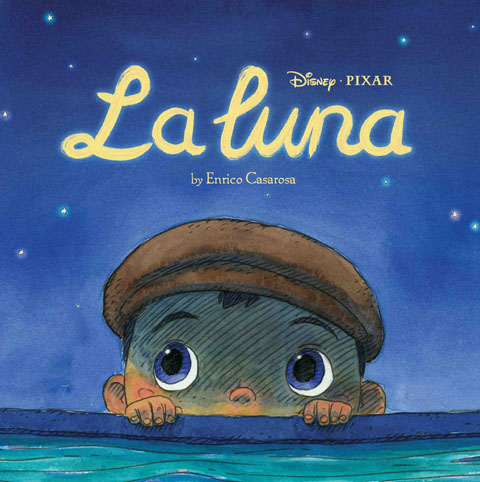
Reading: La Luna by Enrico Casarosa


            Being an avid Disney fan, La Luna was something I'd known about for quite some time before I saw it.  I went to see the new Disney/Pixar film, Brave, and the Pixar short La Luna played before the movie started.  It was a pleasant surprise because I had totally forgot that Pixar plays a short film before their movies.  After leaving the theater I concluded that I enjoyed La Luna more than the film I actually came to see, Brave!  Everything about La Luna made me smile.  From the breathtaking animation to the colorful story to the rich film score, this Pixar short was by far the best they have ever created!  I knew that I would have to buy the book that started it all!
            Now, La Luna is in fact a picture book.  It was a very short read which took a weight off of my shoulders.  During this challenge of reading 50 books in a year, I told myself that I wouldn't cheat – meaning I wouldn't read a handful of small children's books that lay in my closet just to reach my goal faster.  I want to challenge myself.  I would only read a picture book that I felt truly deserved to be read and it had to be one that I had never read before.  Enter La Luna!  The story is about a young boy who journeys out to sea at night with his father and grandfather.  They are going to teach him what they do for a living.  Suddenly in the darkness the moon rises into the sky and the boy's father hands him an anchor and extends a ladder toward the sky, telling the boy to climb it.  The boy climbs with the anchor and when he reaches the top he is lifted up and carried until he is sitting on the moon.  There he discovers what makes the moon and his father's job fantastic while also discovering what makes him special. 
            I can start out this review by saying there was NOTHING I didn't like about this book!  I loved it!  Every bit of it was as fantastic as the Pixar short.  The artwork was beautiful and the writing was very clear and to the point yet so much was said without words.  I loved what the boy's family did for a living and I absolutely loved what the author used to make the moon so special.  I'm leaving out so many details but it is because I want everyone to see the story for themselves because it surprised me so much and I don't want to ruin it!  Anyway, I also loved how during the story the father and grandfather keep doing little things to try to get the boy to act more like one of them (for example – the father wears his hat a certain way and the grandfather wears his hat a different way.  When they give the boy his hat they each try to change the way he wears it and in the end, the boy finds his own way to wear his hat) but in the end the boy finds himself and is still apart of his family. 
            It is no surprise that I'm going to give this book 5 out of 5 stars!  It was amazing.  If you have kids, buy it now!  And if you don't, buy it now for your future kids!  And if you don't plan to have kids, buy it now anyway just to appreciate art!

Reading: Narnia - The Last Battle by C.S. Lewis


            The Last Battle is the seventh and final novel in the Chronicles of Narnia series written by C.S. Lewis.  Let's first start off with a personal note before I go into the review of this book.  I have grown up with the Lion, the Witch, and the Wardrobe but it wasn't until the Disney movie came out that I realized that I'd never actually read the story.  I only heard of it and knew vaguely what it was about.  A store called 5-Below had all seven books after the movie came out and since they were only five dollars each, I bought all seven Narnia books as fast as I could.  Needless to say, I didn't read them as fast as I bought them.  I read the first book in 2006 and now have finally finished the series six years later! Wow!
            The Last Battle is set up just like the other Narnia books (evil befalls Narnia, children from earth arrive to defend Narnia, etc).  It begins with evil invading Narnia when an ape dresses up an innocent donkey to look like Aslan the lion.  He tells Narnians that Aslan has returned and he gives them orders as if he is Aslan's messenger.  The problem is that the orders he is giving are far from any Aslan would ever give.  The donkey lives in a dark hut and people are not allowed to see him, for if they do they will see that he is disguised.  News of Aslan spreads about Narnia and reaches the King.  The King of Narnia, Tirian (the last monarch and the seventh king in descendant of Rilian [from theSilver Chair], son of Prince Caspian X) and his friend Jewel, a unicorn, go to see what madness is brewing outside their castle.  Neither one of them fully believes Aslan has returned and they know something fishy is occurring.  The two of them are then captured by Calormenes (an Empire south of Narnia).  In Tirian's desperate time of need, Eustace and Jill show up and the three of them, along with the help of a few others, prepare for battle.
            Let's start off with the positives about this book first.  One thing I have and always will love about these books is the theological themes that are presented.  Narnia is a huge metaphor of our own world and there is no denying the similarities between the corruption in Narnia's government and our government in America today.  Getting back to theology though…Aslan is God, and just like God he doesn't always show himself in the time of want/need but rather points us in the right direction by signs and teaches us to trust him with faith alone and not be convinced otherwise.  Throughout all seven novels the reader constantly encounters children and Narnians putting their faith in Aslan and never letting go of it.  These books serve as a huge metaphor that can teach kids how faith works and what it means to be a Christian when most others around you are not.  Another thing I liked about this book was the ending.  (SPOILER) When the Pevensie children returned to Narnia and they realized that Narnia was their heaven it just seemed like all the puzzle pieces fit.  It all led up to death.  Susan wasn't there because she stopped believing in Narnia which hints at she lost faith entirely.  I like that C.S. Lewis included this but it makes me sad that Susan would loose her faith.
            Now for the negative aspects of the book.  I found it to be rather boring.  The ending was great and I guess it could be called epic but there wasn't much of a battle.  There were a few close calls and some scary moments but for the most part until the end when (spoiler) Aslan returns, I wasn't too enthused.  Though I can definitely say that C.S. Lewis had me hating the ape that made the donkey pretend to be Aslan.  I just wanted him dead right when I started reading.  I can't say I'm surprised that I was bored because it has happened while reading some of the other Narnia novels.  It feels wrong to insult them and call them boring because I think these books are fantastic but there are just so many boring bits!
            The Last Battle was a great conclusion to the Narnia series.  Although it was boring at times, I loved the Christian metaphors and found the book to be inspiring.  I give The Last Battle 3.5 out of 5 stars.

Wednesday, July 4, 2012

Wasted Wednesdays! --> Folklore in African Literature Seminar Reaction


Welcome to my first Wasted Wednesday post!  If you are new to Wasted Wednesday's...well, so am I.  :)  Welcome!!

I took two courses that lasted five weeks this summer and I knew towards the end of them that I wanted to write about both courses on this blog because I really did learn a lot and had a bit of fun while learning.  One of the courses I took was Folklore in African Literature which is a seminar course and was the only seminar being held at my school during the first summer session (I never do the second summer session - I need a break!).  Looking back to when I scheduled my summer courses, I remember I didn't want to take this seminar but rather the one being held in the second summer session, and now I can't even remember what the other seminar was!  However, despite my preconceptions I found it to be a course with much enjoyment.  It was the first seminar course I have taken during my college years and I have to take two more before I graduate.  As an English major, seminars require very heavy workloads that include lots of reading and writing and they are best taken during the summer so I'm afraid I got an easy look at what seminars are like.

A lot of things stood out to me while taking this course and I always wrote down my thoughts in a notebook so I could remember them when I came to write this blog.  Unfortunately I won't be able to write down full discussions in this blog so everything is going to feel rushed, just to warn you.  We read a lot of books (and I admit, I only read one of the six) and many folktales (I am proud to say I read them all!).  Class met Monday through Thursday from 10:45 to 12:45.  Two hours sitting in a classroom with the cold air blowing on you and your stomach growling isn't always pleasant but you get used to it and like most things we middle class Americans experience, things could be a lot worse.  Our grade was calculated by a five page paper, two presentations, and attendance.  I wasn't too thrilled about the presentations but found they weren't all too bad (mostly because we were allowed to sit down during them which was such a relief), while the paper was a rushed mess that turned out a lot better than expected. There were 14-15 of us in the class and mostly everyone participated and got along.  We all helped each of out when help was needed and our class discussions were always really interesting (although sometimes boring).


Enough about the class environment though.  Let's get to the actual course material.  So I have a few things I wanted to talk about.  Let's first talk about the author I did my first presentation on.  Our first presentations were biography presentations in which we talked about an author of one of the books we were going to read or about the history of one of the books we were going to read.  The author I did my presentation on was a woman named Amma Darko.  The book we read of hers is titled Faceless (still reading).  I didn't get to finish reading Faceless during the course however so far I have really enjoyed it.  The book revolves around a girl named Fofo who lives on the streets in the capital of Ghana, Accra.  It talks about how street children aren't recognized as people but animals and they aren't given a second thought because people don't want to deal with them - hence they are faceless.  This theme is really powerful to me and seems to be prevalent in Darko's other works.  I can't wait to read her other books and I highly recommend you to read her works!

My second presentation was about conflict resolutions in African folktales and literature.  This was another fun topic to explore because it was very personal and left the presentation to be more discussion based rather than me talking for a whole 15 minutes!  One of the themes I loved was forgiveness which is seen in an epic we read called the Mwindo Epic.  In the Mwindo Epic, the title character Mwindo is sought out by his father to be killed.  His father tries to kill him many times until finally Mwindo escapes and goes on a journey (as most epic heroes do).  Mwindo ends up reuniting with his father but instead of killing his father, he forgives him.  His father tried to kill him and yet Mwindo forgives him!  This theme of forgiveness shows that forgiveness is a trait that lives within a true hero.  Most people assume that a character who has evil living inside them must be killed by the hero but this is not the case. 

Another book we read is a more popular title, Things Fall Apart by Chinua Achebe.  I had heard of the book before but had never thought much about it.  I didn't even know what it was about.  To my surprise, I found the story to be rather enjoyable.  It had a powerful message and the characters were so real and alive.  The book definitely deserves all the praise it gets.

My favorite part of the course though was reading the African folktales.  Our class discussed all the aspects of a folktale as well as what folktales usually teach us.  We compared the folktales to Western folktales and saw that while many of the lessons are similar, the stories have their own originality that ties to the culture they came from.  One interesting topic we discussed went along with a folktale about a hare.  In the story there is a drought and so the animals decide to all cut off bits of their ear to sell in the market for hoes and shovels to dig a hole and get water that lays below the earth.  The hare refuses to cut off part of his ears yet still drinks the water the animals find and even takes a bath in it, making it all muddy.  The animals make him run away.  The message of the story was that all people must help contribute to society and work together somehow.  This brought up the question - why?  Why do people have to be apart of society?  I, and most of my classmates, agreed that the hare didn't even try to contribute.  It is understandable that he didn't want to cut his ears but he could have helped in other ways but instead he did nothing.  My professor still argued with us though.  He kept asking, but why?  Why must the hare help?  Why do people need to be apart of society?  I can't go much more into the discussion than that but I will leave the question to you.  I personally still believe people need to contribute to society in some way only for the sake of the world.  It is important to remain conscious that our actions affect others, not just ourselves. Society is a bit messed up so at the same time, I can understand why someone wouldn't want to be apart of it but if you don't want to be apart of it, don't be apart of it.  If you are apart of it in secret then you are still apart of society...if that makes sense.


I pictured this blog to appear very scholarly but now that I have read it over it seems very random and poorly written.  But hey, it is a personal reaction to the course.  Anyway, the point of it all is that I thought I'd learn nothing and I actually learned a lot (or rather, became more knowledgeable in the subject of African folklore) and had fun!  Happy Wasted Wednesday everyone!

Friday, June 29, 2012

My friend, Harry Potter

During my sophomore year of high school I decided to read the Harry Potter books for a second time.  I read the first three and then read the final four in July 2009 after seeing the sixth movie in theaters.  Then in September 2010 I read them a third time and in July 2011, when the final film was released, a fourth time.  The more I read them, the more Harry Potter went from books on a shelf to characters and worlds that were mine.  As strange as it sounds, the Harry Potter series has become a friend to me.  When I pick up the first book tears sting my eyes because it's as if I haven't seen this friend in so long.  When I read the last page I feel a sense of loss.  What now?  It is like I have lost a friend.  But that is the wonderful thing about books - they are always there to welcome you home.
Now it is almost July and suddenly I have the familiar urge to read Harry Potter once again.  It could be that July will be the first anniversary of the final film.  It could be that I watched the final film last night for a film class.  It could be that my friend is reading the first book for the first time and I'm super jealous!  Or it could be that my family is planning on visiting Oswego, NY for a weekend where I seem to read Harry Potter a lot! (Re-read the 3rd book there in 2007, finished the last book there in the summer of 2007, re-read the 4th book summer 2009, and re-read the 5th book there during fall break in my sophomore year of college!)  Wow, that's a lot of "it could's".  Oh, and one more.  It could be that I just bought an awesome Harry Potter shirt!

Needless to say, Harry Potter is a HUGE part of my life.  I've grown up with the books and went from seeing them as just a fantasy series to a series that teaches me to love, accept, and to realize.  That's pretty powerful stuff.  Most people seem to overlook the series for a number of reasons.  1. It's just for kids.  FALSE.  This series is for all ages!  As the story progresses it becomes so dark that it shys away from the kid label.  I hate labels.  People use them to define and stereotype.  2. They aren't scholarly.  FALSE!  Many themes I study as an English major are present in these books.  In a recent article, Suzanne Keen states that Harry Potter themes resemble those of Dickens and students who have read Potter are responding much more to Dickens than students who haven't read the series.  Another thing...at my school, we are constantly forced as English majors to become more aware of non-western literature.  Several of my professors are appalled at our lack of non-western knowledge.  Now this isn't a bad thing however, recently my African Folklore professor said he didn't bother reading the Harry Potter books.  His tone almost suggested that they were a waste of his time.  The street goes both ways here people!  And 3. I'll just watch the movies.  Face plant!  Seriously?  The films are good but they don't hold the magic and literary element of the books.  The films have become such an icon that scholars have come to overlook the series and not take it seriously!  People see Harry Potter as a money spinner, especially after the last film was split into two parts.  And the final film, Deathly Hallows Pt.2 which stands apart from all the others, didn't receive one award from the academy!  Not one!  That says a lot about today's culture.

While Harry Potter has the respect of many there are also those who say it's just a book and it's just something nerds and fan girls read.  I went from an obsessive teenager to a woman who now understands and Harry Potter played a huge part in this.  I am currently collecting all of the U.K. publishing's of the books (three different ones).  I also just submitted an application to record a podcast with Mugglenet Academia to discuss, hopefully, Christianity in the books and I plan to take avid notes when I re-read the books.  I can't wait!  Of course the seven books will go toward my 50 books of 2012 and I hope to read them sometime this summer before the fall semester begins.  I guess this is the English major coming out of me.  :)

Sunday, June 3, 2012

Reading: The Fault In Our Stars by John Green


“But it is the nature of stars to cross, and never was Shakespeare more wrong than when he has Cassius note, ‘The fault, dear Brutus, is not in our stars / But in ourselves.”
John Green, The Fault in Our Stars

NOTE - I'm not quite sure why I say certain things in this review, mainly referring to my apparent love for Augusts Waters. Did I seriously like that whole cigarette thing when I first read the book? I don't remember feeling that way but I want to make it clear that I think it is the most overrated and ridiculous attempt of John Green to make a deep character that, like most of his characters, is stupid. Sorry awesome John Green who I really respect and adore but don't enjoy your books. Sorry. My opinions have vastly changed and I still don't like this book. I want to make a note that John Green's intentions for this book are really great in that people who have cancer in novels and movies always seem to be some kind of martyr and he didn't want to make cancer seem heroic. Cancer sucks. That concept is really deep and cool! But this book is just not that. It is not! I also want to make a few more things clear since I am writing this. The dialogue in this book, which I failed to comment on in both my reviews of this book apparently, is terrible! No teenager is this sophisticated! These kids are practically perfect. In some ways they can be compared to Bella Swan because their perfection is borderline no personality. Yep, I just made a connection to Twilight. No regrets. I felt a need to write this above this review because I want to make the record clear. Thank you. - 09/16/14

In the world of tumblr and youtube and teen angst there is a writer named John Green who is looked at as the god of YA fiction writing.  Over the course of a few years, I have become more and more familiar with John Green and his latest novel was one that I couldn't wait to pick up.  I'd never read John Green before but had only seen him and his brother Hank on youtube (they are the famous Vlog Brothers), and various (I may add – awesome) quotes of his show up all over the internet – some of which you can see on my tumblr page.  Most recently I have also discovered John and his brother created a youtube channel called Crash Course which is quite similar to youtube sensation's Charlieissocoollike's Fun Science except it has a much more in class feel and looks a bit more professional.  Needless to say, it seems like John Green is the man.  But personally, after reading The Fault in Our Stars, I feel it's safe to say that the title of man still goes and will remain with John Williams.  That's a joke by the way…just watch this video and you'll understand. 
            Okay so to the review.  The Fault In Our Stars is a teen love story – girl meets boy and something connects them and they go on this amazing journey together and one dies.  Forgive me for saying this but, this broad storyline was a turnoff for me.  It seems like all we hear today are cheesy love stories.  They are not just in books but in movies and music and TV shows.  Why can't there be a story about girl meets boy and they are just friends?!  I mean, this was a nice love story and all but it wasn't as great as everyone is making it out to be.  It's no Twilight…oh wait.  Scratch that, it's no Pride and Prejudice.  Now I know John Green probably wasn't going for the whole epic love story, or at least that’s what it seems like.  I guess I just assumed this vlog brother awesome nerd fighter would write a book about something other than a teenage love story.  Another thing that turned me off to the novel was the title.  The story seemed to imply that it isn't human's that should be held responsible for what happens on the earth…hence it is the fault in our stars and not ourselves.  Now, that is partly true.  We as humans can't control the weather or where we are born or each other, but we can control ourselves.  You can't blame the stars for the night you got drunk and killed someone while driving.  My opinion is that we all were born with faults and hardships, some more than others, but we are responsible for ourselves and you can't blame the stars for your actions.  Of course you could blame the stars for the life you have been given but there is always someone that has it worse and life shouldn't be a pity party.  It all depends on how you look at situations and how you pick yourself up. 
            So let's go to the positives of this novel because there were many things I did like.  First off, I really liked Augustus.  He was definitely my favorite character of the novel.  I loved that he smoked cigarettes without lighting them to show the cigarette companies didn't have power over him and I loved that he was outgoing and read the book Hazel loved and quoted it and analyzed it.  I also loved when the novel took place in Amsterdam.  The experience Augustus and Hazel shared was one that I think we all have had, even if it wasn't with a significant other.  I also liked that when the character Issac was about to loose his eye sight, Augustus played video games with him.  It was like a ceremony for the last time he'd see a TV screen and be able to play like this…like he was making the most of his last minutes he had left with his eyes.  That was another thing I loved about Augustus.  He understood how to make people feel better and he seemed to always put their needs before his own.  He was selfless.  And one last thing I loved was what Peter Van Houten says: “What a slut time is. She screws everybody.”
            Overall, this book was a good read but I feel it was overrated.  John Green is a great writer but I don't like that he writes mostly teenage love stories.  I still plan to read his other novels so we will see how those ones go for me.  I give this 2 out of 5 stars.
            Anyway, I would love to hear what you guys thought of the novel if you read it.  Do you like John Green?  Do you think my review was accurate or do you disagree with some of my points? Let me know in my tumblr askbox and I will surely answer you with a private message.  I would love to discuss the book with someone!

Friday, May 25, 2012

Reading: Inheritance by Christopher Paolini


            Inheritance is the fourth and final book in the series with the same name.  Before I can begin my review of this book, let me give you a bit of history of this book series.  Christopher Paolini was 15 when he first began writing the first novel of the Inheritance series, Eragon.  The book was first self-published by his parents publishing company and then by a larger publishing company, Alfred A. Knopf, a year later.  It then went to the New York Times best sellers list and remained there 121 for weeks. (x – yes my source is wikipedia) 
            My brother was the one who mentioned the book to me in the beginning.  Both of us were very interested in finding out more about the book.  He ended up buying me the book as a Christmas gift.  I read it during the summer when I was 16.  Since then I have read the following two novels and was intrigued to read the finale.  The first book impressed me, the second wowed me, the third bored me.  I had no idea what to expect for this final novel.       
            The Inheritance series revolves around a young man named Eragon.  Eragon was once a poor farm boy when he found a blue pebble in a place called The Spine by his home.  The pebble, though, was not a mere pebble but a dragon egg.  There in his barn hatched a blue dragon who went by the name of Saphira.  Eragon was then given the mark of a dragon rider and joined the Varden, a rebel group fighting the empire to defeat the horrid King Galbatorix. 
            Inheritance, I found, was everything I would want for the ending of this series.  The details were rich and profound, the characters all showed impressive growth, and the plot was fantastic!  I found myself wondering for a while (even when reading the earlier books), how is Eragon and the Varden going to stop Galbatorix? It seemed impossible!  I know this seems like a spoiler but lets be serious here, it's a young adult book series.  I don't mean to "diss" young adult fiction because I tend to enjoy YA better than adult fiction.  It's expected to have a happy ending.  That being said, Inheritance did have a happy ending but it also was able to encompass that feeling of, what now which made the story seem much more realistic and adult. 
            If I had any complaints about this book series, it would be to ask why it doesn't get more recognition.  Paolini's writing is fantastic for such a young author and his stories and characters are beyond the page!  They stay with you long after you put the book down.  For example, the book series has so many strong and inspiring female characters – to name the most prominent, Nasuada, Arya, and Angela.  I once read an article featured on MuggleNet about the strongest female characters in literature today and one of them was Hermione Granger from J.K. Rowling's, Harry Potter.  Now, don't get me wrong, I LOVE Harry Potter and I think Hermione completely deserves to be on that list.  However, the list is very biased to the so called "popular" novel and while Eragon was a New York Times Bestseller, the series itself doesn't seem to be as loved by the media and therefore doesn't receive the recognition it deserves.  All three of the women I listed above deserved to be on that list. 
            That being said, I also understand why the series is often overlooked.  After watching and reading the horrible film reviews for Eragon (the film was terrible so it deserved bad reviews) and reading audience feedback on the books themselves, I found that the series, in a small way, lacks "originality".  Paolini's world and character's and events are all very original, that is for sure, but the plot line itself is very much like Star Wars and Lord of the Rings.  Being someone who has yet to read Lord of the Rings and see the Star Wars films in full, I did not see this connection until it was pointed out in reviews.  Because of this apparent familiarity, people consider the Inheritance series to be a bunch of books that are just like the next fantasy book series and everything that happens is expected.
            In the end, I enjoyed the series and very much enjoyed the last book.  What I loved most about this book and those previous were the descriptions!  I loved every detail Paolini gave.  While some details were overused, most of the time they were beautiful and jaw dropping.  The last book held so many surprises for me as a reader and while the ending was sad it was also really satisfying.  While critics say it gets too much material from Star Wars, I say none of our stories are completely original.  We all draw our ideas from other ideas before ours.  The Inheritance series shouldn't loose points for a minor detail like that.  I also found that the characters truly were at their best in this last book and I was proud of them!  Paolini wrote an incredible series and for that I give his final book a 5 out of 5 stars.