I must announce before I begin this review that I did not actually read this book page by page. I listened to the audiobook. Before listening, I didn't really think things through about whether this audiobook would be added to my list of books read this year. I feel as if I have cheated in some ways and it does not feel like I have truly read the book but alas I have listened to it chapter by chapter and now I will do my best to write a solid review. I do intend to come back to this book someday and actually read it instead of listening to it because the topic is very interesting and one I would certainly love to look into more.
In The Disappearance of Childhood, Neil Postman makes the argument that childhood is disappearing and at the heart of it's disappearance is technology. While technology adds a lot to our lives and in some ways makes our lives better, it comes at a price. The book is split into two parts. The first part discusses where the idea of childhood came from. To give you a brief history - children used to be believed to be demons because in the Bible it says we are all born sinful and therefore children did not matter all that much. It was when children began to be viewed as innocent beings when born that childhood came about. Childhood is not something that is just apart of life. Sure it is apart of our lifestyle today but childhood is technically an idea, not a state of our lives. At one point in time, there was no big difference between children and adults. Children were not excluded from certain information like they are today such as swearing, sexuality, and death.
The second part of the book then discusses why childhood has disappeared. As I stated above, Postman's main argument is that technology is a huge reason for removing the idea of childhood from our minds. He backs up his argument by saying that technology is the bridge between children and adults. What was once hidden from children in childhood is now easily accessible to them through television and now, the internet. TV is something that anyone can watch no matter what age or background. An image is an image. While books have their own reading levels depending on a person's knowledge of the English language, TV does not have levels. An image is universal while ideas, specifically from books, are not. Therefore, a child can watch a sex scene on Game of Thrones when their parents aren't home and then when their parents watch it, they will be seeing the same image. How they interpret that image is of course based off of their knowledge and experiences and cultural background.
Apart from listening to this book (the fact that I listened to the book while not affect the rating I will give but still...), the other thing I took issue with was that while Postman makes an excellent point, I think there is a lot more at work here than just technology. Of course technology is the biggest issue but my concern is that, what is it that children are now watching and experiencing through technology that is making childhood disappear? Obviously this book was written over 20 years ago when there was no Jersey Shore or Breaking Amish or the Bachelor but I am curious as to what are the effects of certain television programs on children and adults alike? In 1991 when this book was first published, was a show like Seinfeld or Cheers at work on kids the way 16 and Pregnant is at work? What about a movie like Titanic compared to a movie like The Hangover? I would love to read a book about how pop culture is changing childhood.
I really enjoyed this book. After taking a classes such as "Childhood and War Studies" and "Democracy and Education" and reading The Shallows by Nicholas Carr, this book has only pushed my learning on the subject further and I hope it won't end here. I am also certain that this will not be the last Neil Postman book I read. I look forward to the rest of his books! I will give this book 4 out of 5 stars.
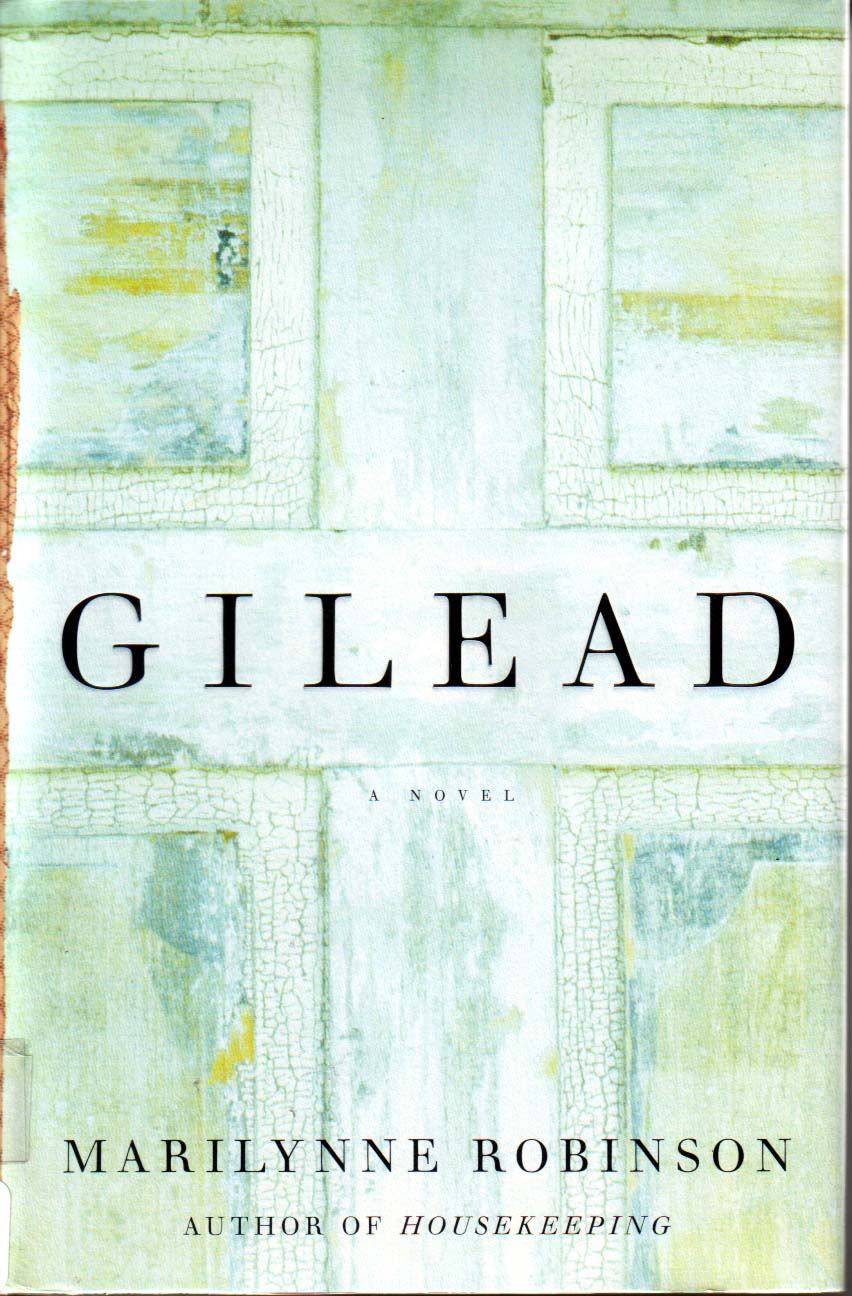
Marilynne Robinson's Gilead is the story of an elderly congregationalist minister named John Ames who resides in the small town of Gilead, Iowa. After finding he has a deadly heart condition, the Reverend decides to write a long letter to his seven year old son in hopes that it will make up for the lack of memories the boy will most likely have. The novel revolves for the most part around John Ames, his father, and his grandfather while also tying into the prodigal son parable with a side story about a friend's son who is named after Ames. The book won the Pulitzer Prize for fiction in 2005.
I came across this book because it was on the assigned reading list for my Christian literature class. I wasn't able to finish it by class time and I never did finish reading it during the semester. Our class had moved onto new works of fiction and I wanted to save the book to read once I had more free time on my hands. Yes, it was that good. I can't call the book a favorite but I have a feeling that if I read it a few more times, it will quickly become a favorite. Gilead is one of those novels that needs to be read more than once. I know, I know...I believe most books need to be read more than once but there are those select few that specifically NEED to be read twice or three times to understand certain sentences and character qualities. It is riveting.
“I
saw a bubble float past my window, fat and wobbly and ripening toward that
dragonfly blue they turn just before they burst…Ah, this life, this world.”
The book was an excellent read. It's main focus was about religion yet it is more so a spiritual/reflective novel than anything else. It doesn't preach to the reader but makes general observations about the world and about God based on main character's experiences. The language is very simplistic and naturalistic and doesn't try to be a happy-go-lucky Christian novel but a realistic novel that embraces the entire picture of the world and really tries to capture in brief glimpses who God is and what He has done and that we as humans will never completely understand Him.
“In
every important way we are such secrets from each other, and I do believe that
there is a separate language in each of us, also a separate aesthetics and a
separate jurisprudence. Every single one
of us is a little civilization built on the ruins of any number of preceding
civilizations, but with our own variant notions of what is beautiful and what
is acceptable – which, I hasten to add, we generally do not satisfy and by
which we struggle to live.”
There seems to be no way for the reader to not relate to the main character in some way. He is a man Gilead mirrors this concept beautifully.
who may be a Reverend but is still just as confused about the world as the next person. He is searching for answers. The story in itself is just heartbreaking, knowing that this man won't get to see his son grow up and his son will soon be without a father. And yet while it is heartbreaking it is also explicitly beautiful. In a way, the story mirrors what the cross is. The cross was a horrifying way to die and yet Jesus carried the it and wore the crown of thorns and hung from his hands that were nailed to the cross - God experiencing human pain and suffering. While the story is dehumanizing, almost, and ugly, it is also wonderful because Jesus died to save us from our sins. A cliche phrase for it would be, a beautiful disaster.
Anyway, it is a must read for any literature geek and anyone who is interested in a rich, literary spiritual novel. 5 out of 5 stars is my rating!
In case you haven't noticed, I love Harry Potter. I've grown up reading the books. Through my experience I have become an avid reader, a writer, and a thoughtful human being. I seriously wonder what my life would look like if the boy who lived had not been apart of it.
When I was in college I dreamed about taking a Harry Potter literature course (or any course for that matter). I loved the books so much and felt that they should be studied just as much as the classics that were typical in the classroom. When I read Shakespeare I saw elements of Harry Potter. When I read Dickens I saw elements of Harry Potter. When I read Jane Austen I saw elements of Harry Potter. I could go on and on about where I saw Harry Potter but I will hold off so I don't bore you to death.

This week's drink is a podcast from the #1 Harry Potter FanSite in the world, MuggleNet! The podcast is titled MuggleNet Academia. On the podcast, MuggleNet staff member Keith Hawk and John Granger, known as the Hogwarts Professor, come together with a special guest, be it a professor, an author, lawyer, etc., and a student guest to discuss literature aspects of the seven novels. I had the opportunity to be apart of this awesome podcast just last month when I was a student guest on Episode 22. The experience was amazing and I can only hope to have more in the future.
The reason I chose this podcast for this week's drink is because so far Thirsty Thursday has featured TV, music, people, and a website. Variety is always swell. But more importantly, I am featuring the show because I think it is absolutely incredible. Potter fans, like myself, have wanted to discuss Harry Potter literature in a classroom environment for quite a long time and instead of waiting for all of the colleges in the world to recognize these books (some colleges do offer Harry Potter courses), MuggleNet took matters into their own hands! They talk about all kinds of different aspects of literature in these books and the result is educational and fun! Plus, it is always a great thing when academia is brought outside of the classroom in creative ways!
I highly recommend you listen to this podcast! It is easily accessible. Just go onto the iTunes store and search MuggleNet Academia and you can download all 23 episodes! If you love to read and if you love literature and, of course, if you love Harry Potter, than you do not want to miss out on this!
And that is the drink of the week! As always I will end this blog by quoting the most interesting man in the world - "Stay thirsty my friends." Talk to you guys next time!
Questions - Have you listened to this podcast? What is your favorite thing about it? What episode did you enjoy the most? The least? Anyone know of a podcast series similar to this that talks about other modern day works of literature such as the Hunger Games or A Song of Ice and Fire? Let me know in the comments!
Many a time I have often asked the question, why is it that the Harry Potter books have resonated so well with me and my life? Not only do I love these books for their literary and alchemical elements but I also love them because of their spiritual elements. While many other books have had huge impacts on my life, none have had quite an impact that can compare to Harry Potter. For the past few weeks I have had the opportunity to immerse myself in all things Harry Potter by listening to podcasts such as Mugglenet Academia (Harry Potter literature discussion) and Alohomora (a global re-read of the books). On top of listening to Harry Potter podcasts, and literature podcasts in general,

I have also had the opportunity to listen to sermons via podcast from some of the best known speakers including Rob Bell, Matt Chandler, Jeff Bethke, and more. My brain has been wired on academia these past few weeks and is forcing me to make some awesome connections between what I am listening to and the things in my own life.
I have many theories as to why I love Harry Potter but a realization has recently come to me that I never once considered but now seems fairly obvious. Community.
The Harry Potter books set up a community for the reader. A diverse group of individuals unite in one thing - that they can do magic. Every person seems to be a friend or an acquittance of another. We see Harry spending time with the Weasley's and feeling like he has a family despite the fact that his family is all gone. We see people helping each other and standing up for one another and strong bonds growing. There is gossip and anger. Kids go out together to drink a pint of butter-beer or play a practical joke or practice a sport. There is an entire area for kids to shop for candy and goodies at Hogsmeade. Hogwarts itself is a mini community where kids have the freedom of being away from home and are able to focus on what is important with their friends. And for some odd reason, I feel as if I can relate to this picture completely. If there is any reason for me wanting to enter Harry's magical world, it is because of the community. I would love to be apart of the Hogwarts community.
As a kid, this was not the case. I did not want to go to Hogwarts and often wondered why my peers did want to go. After all, why would I want to go to a school where there is so much danger lurking about? And the Wizarding World? I would never count on going there either. So how come my perspective has shifted so much? My only guess is that it is because I have had a similar experience since reading the books as a ten year old.
Reading these books brings me a feeling of nostalgia, partially because they were a huge part of my childhood and a huge part of my adolescence. But another reason I feel nostalgic is because I feel as if I have already lived similar to Harry. When I read Harry Potter, the emotions I feel mirror the emotions I felt when I was apart of youth group as a teen. This is a huge connection as to why I find the books spiritual as well.

Youth group was something I always looked forward to as a teen. One of the best times I had was when I would go with my fellow teens to church youth camp in Montrose, Pennsylvania. Although we were only at camp for a week, the experience was very much similar to going away to Hogwarts. We each were a part of our own cabin, we went away to study the bible with our friends and have fun at the same time, and it felt like we were apart of a big family. This seems to mirror Hogwarts. At camp we sometimes groaned when we had to read our bibles but ultimately during that one week over the summer when we were at camp, we found we were happier and more connected to God than ever before. That is what I think of when I read Harry Potter. The characters seem connected and I feel that connection to them. When I read these books, I witness a lot of happy and healthy communities that have many differences and at times negativity and they struggle but they always pull together and are united. This can teach Christians a lot when it comes to our own communities.
WARNING - CONTAINS SPOILERS
I don't think I can begin to explain just how excited I was to pick up the next book in the A Song of Ice and Fire series. A Clash of Kings sat on my bookshelf for many months and although I was eager to read it sooner than later, I forced myself to hold off until my college semester was over so that when I went to read it I would not be distracted by other books required for classes that would immediately take precedent. This book needed to be my focus.
After reading the first book in this series, I knew I was hooked. A Game of Thrones, now one of my favorite books, is a book richly character driven and incredibly real. I have also been a relatively large fan of the HBO TV Series which was another reason for me to read this book. I wanted to watch the second season but didn't want to watch it before I read the book. I was indeed in a pickle.
While I was highly anticipating this read, I was also a bit cautious. Many people have told me that the books grow worse and worse. It has been said that George R. R. Martin tries to do too much and that the books begin to go all over the place with too many story lines. Do I agree with that after reading the second book - yes. A Clash of Kings seems to be the start of an insanely complex story-line full of multiple points of view and a huge amount of small plots combined with the overarching theme - who will take the iron throne?
A Clash of Kings starts right where the last book left off. Joffery is still King of the realm while Robb fights to be King of the North and gain vengeance for his father's death. Across the narrow sea is Daenerys Targaryen with her dragons, desperately trying to find ships so she can sail to Westeros and claim the throne that rightfully belongs to her. All the while, King Robert's brothers are at odds at who should have the right to the throne - Stannis, the eldest, or Renly, the favored.
"Paint
stripes on a toad, he does not become a tiger."
Martin continues with his multiple perspective narration and adds a few new voices to the story which includes Davos Seaworth, an ex-smuggler now a knight for Stannis Baratheon and Theon Greyjoy. The narrators from the last book remain, except of course for Ned. I have flipped through the next two books a bit and see that two mores narrators are to enter the pack and possibly more. With that in mind, this book also introduces many new story-lines and complexities. Martin is an expert when it comes to this and he excels at creating multiple characters that are completely unique to themselves and their world. I'm having a hard time figuring out where to begin to explain all that Martin introduces throughout this installment, and perhaps I shouldn't even talk about it because I don't want to give away an spoilers. I will say this - with all of the new perspectives and all of the

new story-lines and individual character issues, these books are going to be a hell of a hard read. I am concerned as to if they will stay consistently good or if indeed, as my friends warn, they will go downhill because there will be too much going on. I have a feeling it will be both because while they may go downhill, I have no doubt Martin will still be able to capture his characters as well as he did the first time around. The story may be doing too much and may not have enough of a focus on one element but that may play to the story's strength's, not weaknesses.
"'He
has a song,’ the man replied. ‘He is the
prince that was promised, and his is the song of ice and fire.'"
The thing I enjoyed most about this reading experience though was being able to combine it with watching the adaption on the big screen. What this TV adaption has that many adaptions don't is credibility - that things are more often than not the same as they were in the book. Scenes are done incredibly well and the actors are spot on. The second season seems to be slipping away from the book a bit more than the first but it is still done incredibly well. I re-watched the first season as I read this book and it was a real team experience. Say a character popped up and I had no idea who he/she was. I would watch an episode the next day from the first season and there the character would be. I was therefore able to see how certain characters originated (it seems I forgot quite a bit) and I applied that knowledge to my place in the book. It was a great experience.
In the end, A Clash of Kings is without a doubt just as good as A Game of Thrones. Although there is a bit too much going on, the book stays consistent in tone and character development as well as in plot, keeping me engaged and wanting more. I will give the book 4 out of 5 stars.